
The Child Catcher: Forgotten Horror Icon of Chitty Chitty Bang Bang
Written by Jeff Stone (Published by Patrick Stone)

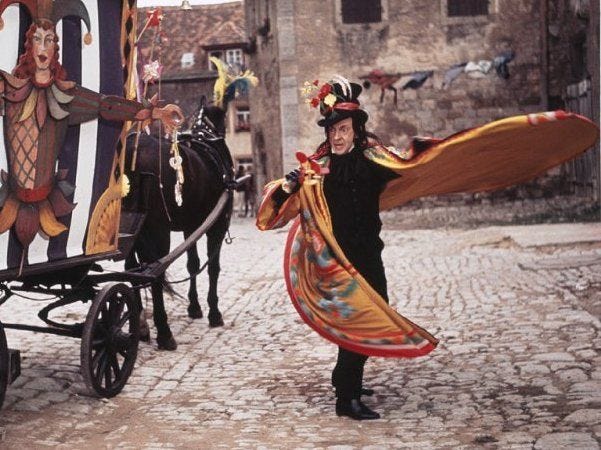
Few characters in family‑friendly cinema have inspired as much unease as the Child Catcher from Chitty Chitty Bang Bang. Unveiled to the world in the 1968 film adaptation of Ian Fleming’s whimsical story, this one‑off antagonist has become, in the decades since, the touchstone for childhood fear, the bogeyman you don’t physically see in your closet, but can feel in your bones. If you grow up in a generation that was shown this movie before age 12, you understand: the Child Catcher isn’t a quirky villain. He’s a terrifying figure, a legitimate horror antagonist dressed in nanny’s clothes and wielding hooks like an executioner.
And perhaps that’s precisely why, almost sixty years later, the cultural conversation has shifted. More and more frequently, fans and critics alike describe the Child Catcher not as a campy relic of 1960s musicals but as a proto‑horror villain, a figure whose design, purpose, and thematic role in the story resonate with what the modern horror genre has refined over generations. This isn’t hyperbole. The character’s imagery is uncomfortable at best and genuinely disturbing at worst: dark clothing contrasted with unnatural stillness, predatory body language, and a voice that sounds both officious and unhinged. There’s a reason his scenes make adults flinch when they revisit the film.
Let’s be honest with ourselves. Chitty Chitty Bang Bang was marketed as a musical fantasy, and on its surface it is full of bright colors, catchy songs, and adventurous spirit. But every time the narrative slides into Vulgaria, a made‑up kingdom ruled by Child Catcher, worshipping elites, the tone darkens. The character’s entire narrative function is to snatch children, to patrol the hills like a warped tax collector of innocence. In a film about flying cars and magical adventures, the Child Catcher’s scenes are the outlier: they are scenes of abduction and terror. To modern sensibilities, that aligns more with horror than family entertainment.
This isn’t just fan exaggeration. The design choices are what haunt adults who saw the movie young and still flinch when the memory surfaces. His lanky silhouette, black hat, and disproportionate features don’t give the comfort of whimsy, they suggest menace. His entrance, often silent until startled, feels like a moment lifted from a gothic nightmare. His tools aren’t comically oversized; they’re utilitarian and chilling.
In the lexicon of horror villains, certain characteristics define a predator: mysterious motive, willingness to harm innocents, and a presence that disrupts the safety of childhood spaces. Whether a slasher, a supernatural ghost, or a masked killer, terror in horror grows from violation: violation of trust, violation of safe space, violation of innocence. The Child Catcher, by design, is the embodiment of that violation. He doesn’t merely oppose the protagonists; he steals what is most precious to them, children, and does so with glee and bureaucratic pride.
Compare him to iconic horror figures like Freddy Krueger or Michael Myers. They operate in different modes, one surreal and dreamlike, the other silent and unstoppable, but they share an essence: they take something essential from their victims. The Child Catcher doesn’t kill or haunt dreams; he kidnaps joy and terrorizes families. That’s visceral. That’s primal. That’s horror.
What makes the Child Catcher a fascinating case study is how context matters. In 1968, audiences might have accepted his presence as part of fantasy poignancy. Today’s audiences, steeped in decades of genre evolution, interpret him differently. When horror becomes a framework for understanding emotional threat, he fits the archetype with alarming precision.
Recently, this interpretation has begun seeping into cultural critique. On social platforms and in film theory circles, commentators don’t merely discuss the Child Catcher as “the scariest part of a kids’ movie”, they analyze him as a horror villain archetype before the genre fully codified its rules. They compare his calculated menace and lack of empathy to horror antagonists whose only delight is in control and fear. They note that his scenes don’t adhere to the musical’s rhythm so much as interrupt it with dread. This is not nostalgia talking; it’s genre literacy.
And yet, Hollywood has never officially positioned him this way. The many attempts to revisit Chitty Chitty Bang Bang in theaters, television, or adaptations never deepen his character into a horror antagonist. Why? Because mainstream entertainment still wants to preserve the film’s family‑friendly brand, its whistling tunes and flying car glee. But that reluctance says less about the character’s nature and more about what studios believe audiences can be sold. The Child Catcher, reframed as a horror figure, challenges the sanitized view of childhood media, and that’s commercially risky.
It’s worth noting that no major studio has announced a horror spin‑off or reimagining of the Child Catcher. There are no scripts in development or directors attached. What is developing is the conversation: critics and viewers no longer laugh off the character’s creepiness as an unfortunate side effect. They treat him as a legitimate villain with thematic weight, a psychological predator in a world that otherwise sells fantasy.
The broader implication here is how modern viewers reinterpret older media. Stories from decades past come with layers of cultural framing that shift over time. Where once a villain was a foil for adventure, today that same villain becomes a case study in fear. Context changes meaning. And in the case of the Child Catcher, the horror was always there, we just didn’t have the language to articulate it.
At a deeper level, this reclassification matters because it speaks to how we understand the emotional lives of children on screen. Terrifying figures in children’s media are not accidental; they represent the anxieties we carry about loss, powerlessness, and the fragility of safety. When the Child Catcher steps into a scene, he doesn’t just threaten characters, he visually and psychologically violates the logic of the story’s safe space.
So when people talk about the Child Catcher as a horror villain, they aren’t being melodramatic. They’re recognizing that the emotional chord he strikes aligns with what true horror aims to evoke: a confrontation with the dark side of human imagination. For many adults, that memory never fully leaves them.
In the end, the Child Catcher’s legacy isn’t just about nostalgia or childhood fear. It’s about the thin line between whimsy and dread, and how a single character, constructed within a film marketed to families, can endure as an icon of cinematic terror. We may never see him reimagined in a horror franchise, and perhaps that’s for the best in commercial terms. But as a character, he stands among the unsung early antagonists whose true horror was always hidden in plain sight, beneath a top hat and behind a coal‑black coat. And for those who remember that first unsettling encounter with him, the fear was never just pretend.