
The Fan Made Meat Grinder

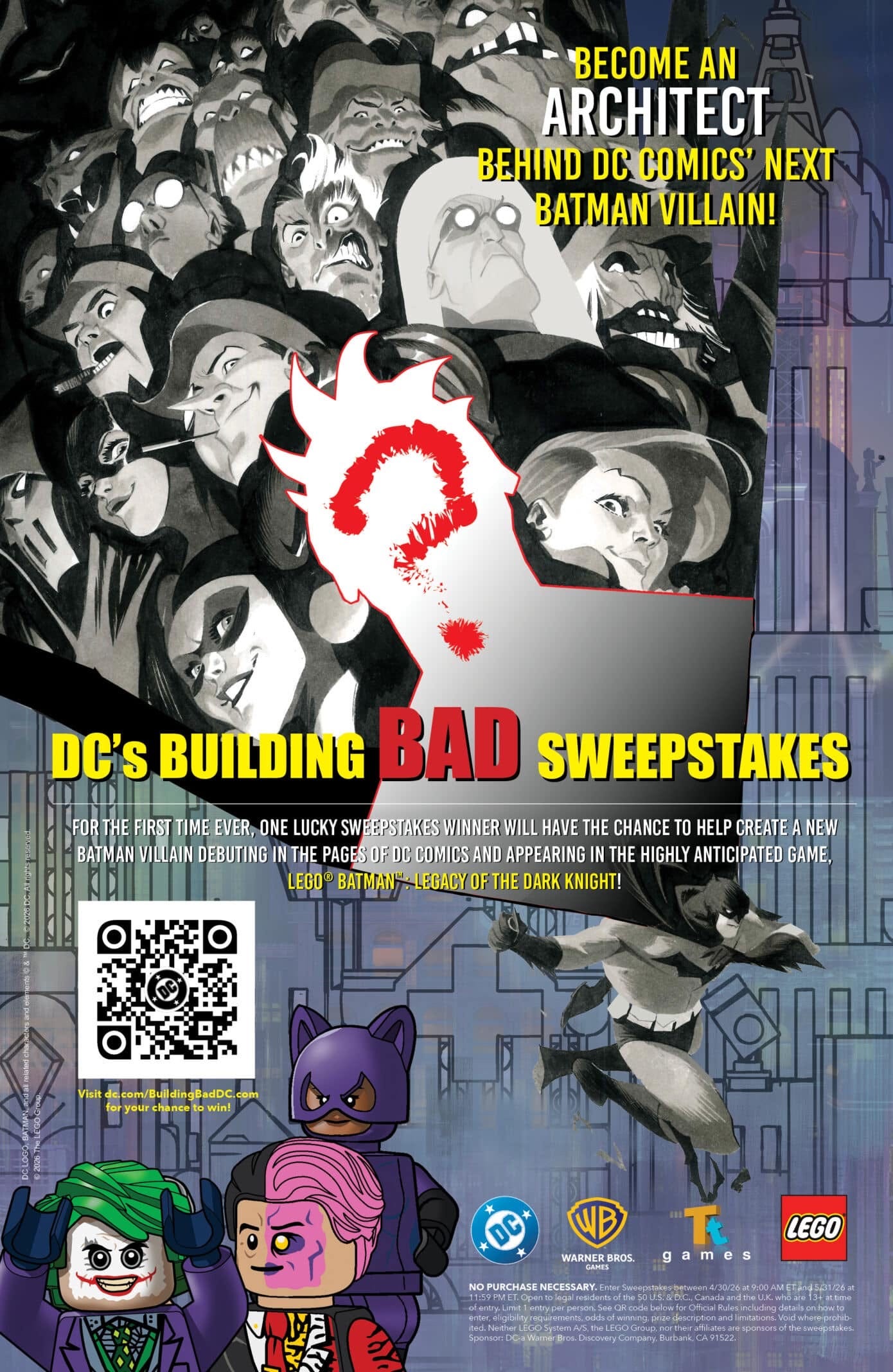
The modern comic book industry operates as a perpetual motion machine of intellectual property retrieval, an corporate ecosystem that simultaneously commodifies the enthusiasm of its audience while keeping its structural architects locked in a gilded cage of work-for-hire contracts. The latest manifestation of this dynamic arrives in the form of DC Comics launching their Building Bad Sweepstakes, a marketing stunt disguised as a democratic celebration of fandom, which promises a single civilian the opportunity to collaborate with the corporate braintrust to craft a brand-new Batman supervillain. This shiny new antagonist is scheduled to debut this coming September across a synchronized cross-media offensive, making landfall in the pages of Detective Comics number eleven-thirteen, appearing in Matt Fraction and Jorge Jimenez's primary Batman run, popping up in a localized DC GO webcomic for Batman Day, and embedding itself directly into the downloadable content of the upcoming video game LEGO Batman, Legacy of the Dark Knight. On the surface, the narrative spun by Warner Bros Discovery publicists is one of unprecedented access, a literal childhood dream monetized into a ten-thousand-dollar grand prize where a teenager from the United States, the United Kingdom, or Canada can see their notebook doodles elevated to the official canon of Gotham City, standing alongside the Joker, the Riddler, and Catwoman. Yet, beneath the corporate benevolence lies the unchanging, razor-sharp machinery of legal exploitation that has defined the American comic book industry since the days when Jerry Siegel and Joe Shuster sold the rights to Superman for a hundred and thirty-eight dollars, proving that while technology and delivery systems evolve, creator rights remain an absolute sham.
To truly understand why a fan contest is less an act of artistic generosity and more a calculated legal vacuum cleaner, one must look at the specific architecture of the legal releases attached to these corporate sweepstakes. When a fan fills out the submission form, detailing character traits, narrative backstories, and aesthetic visual motifs, they are not entering a collaborative partnership, they are signing an absolute, irreversible waiver of intellectual property ownership that permanently strips them of any future claim to the character. If this fan-created villain happens to strike a chord with the zeitgeist, if it becomes a cinematic mainstay, if it gets turned into millions of plastic action figures or anchors its own spin-off television series on Max, the original creator will receive exactly zero dollars in residual compensation beyond that initial lump-sum prize. This is because corporate comic book publishing has perfected the legal doctrine of work-for-hire, an arrangement wherein the corporation is legally designated as the author of the work from the moment of its conception, leaving the actual human being who breathed life into the concept completely divorced from the financial legacy of their own imagination. By opening the floodgates to fan submissions, DC is effectively outsourcing their conceptual research and development to an eager, unprotected workforce that is so blinded by the romantic notion of contributing to the mythology of the Dark Knight that they will willingly sign away rights that professional creators have spent decades fighting to protect.
The history of comic books is a graveyard of broken, exploited geniuses who built the foundations of modern pop culture multi-billion-dollar cinematic universes while living in near-poverty, a historical reality that makes this new fan contest feel remarkably cynical. Consider Jack Kirby, the co-creator of the Marvel Universe whose estate fought for decades to achieve even a modicum of recognition and financial restitution, or Bill Finger, the man who actually conceived Batman's costume, his cowl, his tragic origin story, and the vast majority of his rogues gallery, yet died broke and uncredited while Bob Kane reaped the rewards of a uniquely predatory contract signed in nineteen-thirty-nine. Even in the modern era, the battle lines remain drawn, as contemporary writers and artists frequently speak out about the meager character equity checks they receive when their creations anchor blockbuster films, often amounting to a fraction of a percent of a movie's opening weekend box office receipts. When a massive media conglomerate bypasses professional creators to source a new villain from a sweepstakes, it is not just engaging with the community, it is actively proving that it views the act of creation as an interchangeable, low-cost commodity that can be extracted from anyone willing to trade their long-term intellectual property rights for a brief moment of internet fame and a giant novelty check.
What makes the Building Bad Sweepstakes uniquely contemporary is its seamless integration into the broader corporate apparatus of corporate synergy, proving that a single fan creation is expected to immediately perform labor across multiple corporate divisions. The character is not merely a narrative experiment in a comic book, it is a pre-packaged asset designed to move merchandise and digital downloads, explicitly tied to the promotional cycle of a major video game release, and formatted for the bite-sized consumption of mobile webcomics. This multi-platform deployment highlights the sheer scale of the wealth gap between the entity that owns the copyright and the individual who thought up the character, because while Warner Bros Discovery utilizes this fan-generated villain to drive engagement for its interactive entertainment divisions, the human creator remains static, trapped in a legally binding agreement that ensures their contribution is a historical footnote. The industry's insistence on maintaining this dynamic reveals a profound institutional terror of true creator equity, a fear that if creators, even civilian fans, are given a legitimate stake in the financial lifecycle of their intellectual property, the corporate margins might shrink by a fraction of a percent. By framing this extraction of labor as a fun, interactive community event, the publisher successfully gamifies the surrender of intellectual property, normalizing the idea that creating something for a mega-corporation is an honor that transcends the need for fair, long-term compensation, keeping the grand illusion of the comic book industry alive while the meat grinder keeps spinning behind the curtain.